
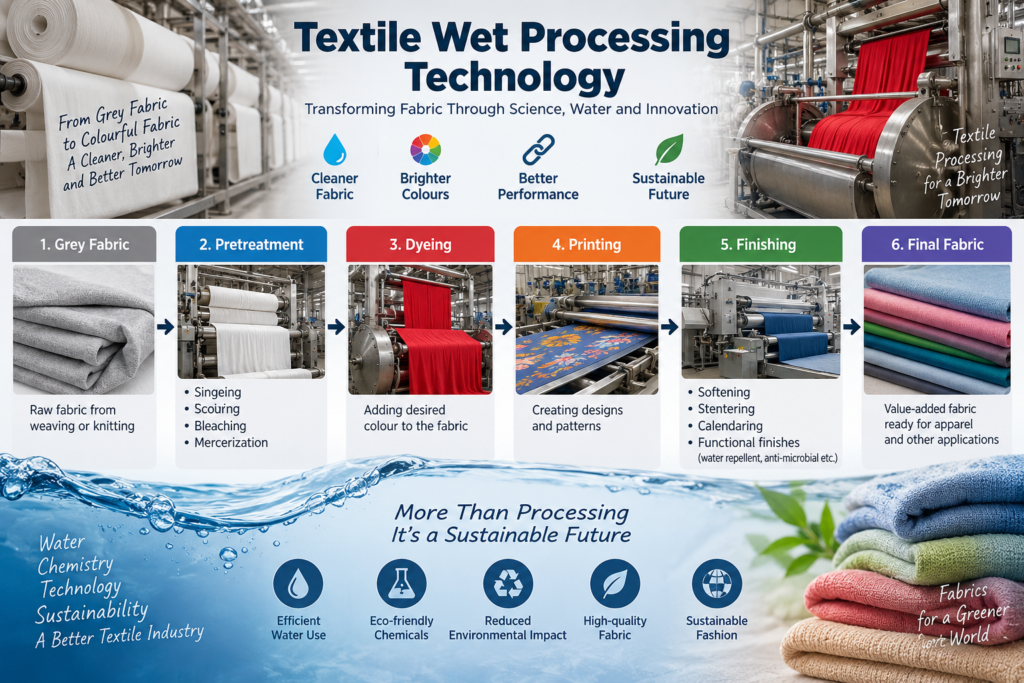
Textile Wet Processing
Learn textile wet processing technology end-to-end: pretreatment, dyeing, printing, finishing, machinery, chemicals, ETP, and sustainability.
Every colored, printed, or finished fabric you have ever worn went through wet processing. At this stage, textile professionals transform plain grey fabric, straight off the loom or knitting machine, into the finished textile that a garment factory can cut and sew. Therefore, understanding this stage matters whether you are a technologist running a dyeing floor, a merchandiser approving a lab dip, or a buyer trying to understand why a supplier’s lead time or cost structure looks the way it does.
This guide walks through the complete textile wet processing technology chain — pretreatment, dyeing, printing, finishing, machinery, chemicals, quality control, sustainability, effluent treatment, and the specific context of Bangladesh’s export-driven textile industry.
What Is Wet Processing?
Textile wet processing is the group of chemical and mechanical operations that use water, heat, and chemicals to clean, whiten, color, print, and finish textile materials. It covers everything that happens after manufacturers weave or knit a fabric and before garment factories cut it into panels.
The name comes directly from the process itself. Nearly every step — scouring, bleaching, dyeing, washing, and most finishing — takes place in an aqueous (water-based) medium. Therefore, this distinguishes wet processing from “dry processing” operations such as spinning, weaving, and knitting, which do not require water as a processing medium.
Within the overall textile manufacturing chain, wet processing sits between fabric formation and garment manufacturing. First, fiber becomes yarn. Then, yarn becomes grey fabric. Finally, grey fabric enters wet processing, where textile professionals transform it into the colored, printed, or finished fabric that garment factories actually use. As a result, wet processing quality directly determines the final quality, appearance, and performance of finished apparel.
Why Is Wet Processing Important in Textile Manufacturing?
Textile wet processing adds much of a fabric’s commercial value. Grey fabric remains functional, but it cannot meet most apparel requirements. Therefore, wet processing makes it desirable, wearable, and brand-appropriate.
It directly shapes several properties that buyers and consumers judge a garment on:
• Appearance: Impurities are removed during wet processing, while the required whiteness, brightness, or exact shade is developed.
• Color: Through dyeing and printing, manufacturers create the color story of a collection, including multi-tone effects and prints.
• Handle (hand feel): Softening and other finishing treatments determine whether a fabric feels soft, crisp, dry, or silky.
• Comfort: In addition, finishing can improve moisture absorption, breathability, and next-to-skin comfort.
• Performance: Functional finishes provide properties such as water repellency, anti-microbial protection, wrinkle resistance, or flame retardancy.
• Durability: With correct pretreatment and dyeing chemistry, the fabric can better withstand repeated washing and wear.
• Absorbency: Natural waxes and impurities are removed through scouring and bleaching, allowing better dye and moisture uptake.
• Colorfastness: Proper dyeing and fixation help the color withstand washing, rubbing, and perspiration.
• Functional properties: Many technical and sportswear fabrics rely on finishing chemistry to achieve their marketed performance claims.
For a merchandiser, poor wet processing shows up as rejected shipments, off-shade lots, and colorfastness failures. Similarly, for a fabric manufacturer, it shows up as reprocessing costs, water waste, and lost production time. Therefore, getting wet processing right can make the difference between a profitable order and a costly claim.
Main Stages of Textile Wet Processing
Textile wet processing follows a sequence that takes grey fabric through pretreatment, dyeing, printing, washing, finishing, and final inspection.
Most wet processing follows a broadly consistent sequence, although the exact order and steps depend on fiber type, fabric construction, and the final product requirement.
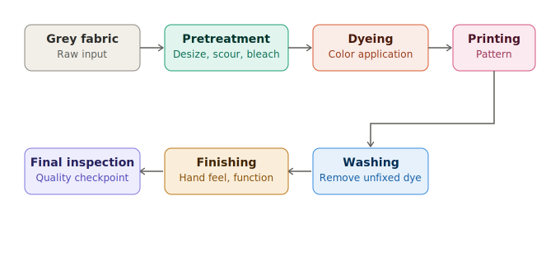
Grey Fabric → Pretreatment (Desizing, Scouring, Bleaching, Mercerization, Singeing) → Dyeing → Printing (where applicable) → Washing → Finishing → Final Inspection
• Grey fabric is the raw, unprocessed fabric that comes directly from weaving or knitting.
• Pretreatment: This stage removes impurities, sizing agents, natural waxes, and seed particles. In addition, it prepares the fabric to absorb dye and chemicals evenly.
• Dyeing: Manufacturers apply color using dyes suited to the specific fiber type.
• Printing: Where required, this process applies localized color patterns instead of, or in addition to, solid dyeing.
• Washing: After dyeing or printing, washing removes unfixed dye, chemicals, and surface residues.
• Finishing: Mechanical and chemical treatments determine the final hand feel, dimensional stability, and functional performance.
• Final inspection: Quality teams check the fabric against agreed quality parameters before the factory approves it for cutting.
However, not every fabric passes through every stage. For instance, a grey woven fabric destined for a garment-dyed product may skip fabric dyeing entirely and go straight to cutting, sewing, and garment washing instead.
Textile Pretreatment
Pretreatment prepares raw fabric for dyeing, printing, and finishing by removing impurities that could otherwise cause uneven color uptake, poor absorbency, or dull appearance. Therefore, it remains arguably the single most important stage for downstream shade consistency because dyeing cannot correct a poorly pretreated fabric.
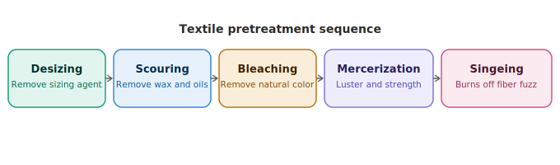
Textile pretreatment sequence: desizing, scouring, bleaching, mercerization and singeing
Desizing
Woven fabrics receive a sizing agent, typically starch or synthetic size, before weaving to strengthen the warp yarn and reduce breakage on the loom. Desizing removes this size using enzymes, acids, or oxidizing agents. As a result, the fabric can absorb water and dye uniformly. Without proper desizing, dye uptake becomes patchy, and finishing chemicals cannot penetrate the fabric evenly.
Scouring
Scouring removes natural and added impurities — waxes, oils, pectins, and residual sizing — using hot alkali, commonly caustic soda, along with wetting agents and detergents. Consequently, the process produces a clean, highly absorbent fabric that can take up dye evenly. Moreover, scouring efficiency has a direct, measurable effect on final shade reproducibility.
Bleaching
Bleaching removes natural coloring matter from the fiber, most commonly with hydrogen peroxide under alkaline conditions, to achieve the required degree of whiteness. This process is essential for pale shades and pure white finishes because residual natural color could distort the final shade. In addition, bleaching improves the fabric’s overall cleanliness and absorbency alongside scouring.
Mercerization
Mercerization treats cotton fabric or yarn with concentrated caustic soda under tension, which permanently swells the cotton fiber. As a result, this process increases luster, strength, and dye affinity. Therefore, mercerized cotton fabrics often show a noticeably richer, deeper shade for the same dye recipe. Mills typically apply mercerization to higher-value cotton fabrics where luster and color depth matter commercially.
Singeing
Singeing passes the fabric surface briefly over a gas flame or heated plate to burn off protruding fibers (“fuzz”) without damaging the base fabric. Consequently, this produces a smoother surface, reduces pilling tendency, and improves the sharpness of subsequent prints. Singeing is common for woven fabrics and less common for most knits, where manufacturers often prefer a certain surface texture.
Textile Dyeing Process
Textile dyeing applies color to pretreated fabric so the fabric absorbs and retains dye uniformly and permanently. Generally, the dyeing process follows three broad phases: dye exhaustion, where dye migrates from the dyebath onto the fiber; fixation, where dye chemically or physically bonds to the fiber; and washing-off, where workers remove unfixed dye and chemicals.
The correct dye class must match the fiber. Otherwise, using the wrong dye class can result in poor color yield, weak colorfastness, or complete dye rejection by the fiber.
Types of Textile Dyeing
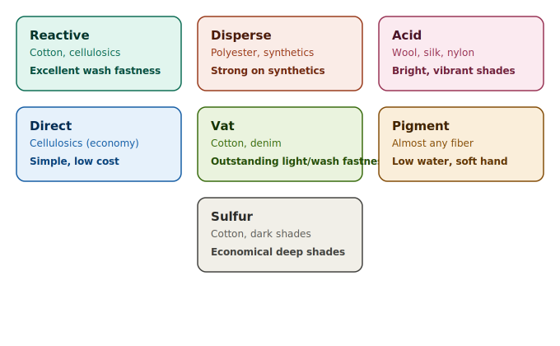
Comparison chart of seven textile dye types by suitable fiber and key advantage: reactive, disperse, acid, direct, vat, pigment and sulfur
Reactive dyeing is the dominant method for cotton and other cellulosic fibers. Reactive dyes form a covalent bond with cellulose, providing excellent wash fastness. Mills widely use them for knit and woven cotton apparel, although the process requires salt and alkali, creating sustainability concerns.
Disperse dyeing is used mainly for polyester and other synthetic fibers. Disperse dyes penetrate polyester at high temperatures, typically through high-temperature/high-pressure (HTHP) dyeing. This method provides excellent color fastness but is unsuitable for natural fibers.
Acid dyeing is commonly used for wool, silk, and nylon. Under acidic conditions, acid dyes bond with amine groups in these fibers. They produce bright, vibrant shades and are widely used for nylon activewear and fine wool or silk products.
Direct dyeing applies water-soluble dyes directly to cellulosic fibers without a chemical reaction. It offers a simple and economical process but generally provides lower wash fastness than reactive dyeing.
Vat dyeing chemically reduces dyes into a soluble form before application and then re-oxidizes them inside the fiber. It remains the classic method for denim and provides excellent wash and light fastness, although it requires a more complex chemical process.
Pigment dyeing attaches pigment particles to the fabric surface using a binder rather than chemically bonding with the fiber. It works with various fibers, uses relatively little water, and creates a soft, faded appearance. However, rubbing fastness can be lower than reactive dyeing.
Sulfur dyeing is mainly used for cotton in deep shades such as black, navy, and brown. It is economical and provides good wash fastness, making it common in workwear and casualwear. However, its reduction chemistry requires proper effluent management.
Textile Printing Process
Textile printing applies color in a specific pattern rather than as a uniform solid shade. In addition, it uses many of the same dye and pigment chemistries as dyeing, but applies them through a paste rather than a liquor bath.
Screen printing forces color paste through a mesh screen with a stencil pattern using a squeegee. Therefore, it remains widely used for simple, high-volume, few-color designs. Rotary screen printing automates this process with cylindrical screens on a continuous printing line. As a result, it enables much higher production speeds for multi-color designs on long fabric runs.
Digital textile printing uses inkjet technology to print designs directly onto fabric without screens. Consequently, it works particularly well for complex, photographic, or frequently changing designs and for short-run or sample production. However, it generally carries a higher per-meter cost than screen printing at scale.
Pigment printing uses pigment paste fixed with a binder and works on virtually any fiber. Therefore, manufacturers value it for its soft-to-firm hand feel and process simplicity, although it can provide lower rub fastness than reactive printing.
Reactive printing uses reactive dyes in paste form for cellulosic fibers. As a result, it gives bright, wash-fast prints with a soft hand feel, but it requires more elaborate steaming and washing-off steps than pigment printing.
Discharge printing first dyes the fabric a solid ground shade. Then, textile professionals print a chemical paste that locally destroys or “discharges” that color to create a pattern. This technique produces intricate light-on-dark designs, although it demands careful chemical control and generates additional effluent load.
Textile Finishing Process
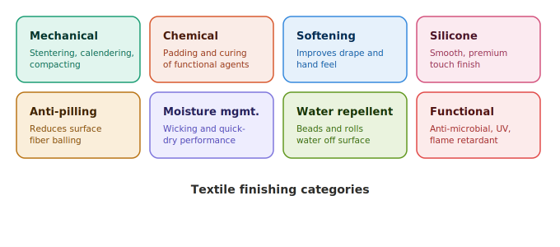
Finishing represents the final stage that converts dyed or printed fabric into a product-ready textile with the specific hand feel, dimensional behavior, and functional performance that a design brief calls for. It can broadly include mechanical and chemical treatments, and mills often apply both together.
Mechanical Finishing
Mechanical finishing changes the fabric’s physical structure using heat, pressure, or physical action rather than chemicals. This includes stentering, which heat-sets the fabric to a target width and controls shrinkage; calendering, which presses fabric between rollers for a smoother, sometimes glazed surface; and compacting, which controls shrinkage in knit fabrics, especially for wash-and-wear performance.
Chemical Finishing
Chemical finishing applies functional or aesthetic chemistry to the fabric surface, usually through padding and curing. This category covers most specialized finishes below. Therefore, it accounts for a huge share of the marketed performance claims associated with a fabric.
Softening
Softening treatments — using silicone, cationic, or specialty softeners — improve fabric drape and hand feel. As a result, they make fabric more pleasant against the skin. This remains one of the most commonly applied finishes across nearly all apparel categories.
Silicone Finishing
Silicone-based softeners deliver a particularly smooth, slightly slick hand feel. Consequently, mills widely use them on both wovens and knits where a premium touch is required. Different silicone chemistries, from basic to amino-modified types, provide a range of hand-feel outcomes at different cost levels.
Anti-Pilling Finishing
Anti-pilling treatments reduce the formation of small fiber balls, or pills, on the fabric surface during wear and washing. This is especially important for knitted synthetics and blends that tend to pill. Furthermore, mills frequently combine anti-pilling treatment with enzyme treatments during wet processing.
Moisture Management
Moisture-management finishes improve how quickly a fabric wicks sweat away from the skin and dries. Therefore, they represent a key requirement for activewear and performance apparel. These finishes work by modifying the fiber surface’s wetting and capillary behavior.
Water-Repellent Finishing
Water-repellent (DWR) finishes cause water to bead and roll off the fabric surface rather than soak in. Mills commonly use these finishes on outerwear, workwear, and technical fabrics. However, buyers should note the ongoing industry shift toward non-fluorinated DWR chemistry, driven by regulatory and sustainability pressure.
Functional Finishing
Functional finishing covers specialized performance treatments such as anti-microbial, UV protection, flame retardant, and wrinkle-resistant (easy-care) finishes. Manufacturers typically specify these treatments according to end-use category. For example, they may use flame-retardant finishing for workwear or UV-protection finishing for outdoor apparel.
Textile Wet Processing Machines
Wet processing relies on a defined set of machines matched to each stage of the process.
In pretreatment and dyeing, the most common machines include the jet dyeing machine, which circulates fabric rope in a pressurized liquor jet and is widely used for knit fabrics. The soft-flow dyeing machine provides a gentler, more water- and energy-efficient evolution of jet dyeing and has become an industry standard for many mills. Meanwhile, the winch dyeing machine offers an older, simple rope-dyeing system that mills still use for lower-tension-sensitive fabrics. The jigger handles open-width woven fabric dyeing while minimizing crease marks. Finally, the continuous bleaching range processes open-width fabric through sequential desizing, scouring, and bleaching baths at high speed, making it suitable for large-volume woven fabric production.
For finishing, the stenter, or “stenter frame,” controls fabric width, applies heat-setting, and often applies finishing chemicals in a single continuous pass. Therefore, it remains one of the most critical machines in the finishing department. The compactor controls residual shrinkage in knit fabrics after dyeing, while the padder applies chemical finishing liquor evenly across the fabric width before curing.
Washing ranges remove unfixed dye and chemicals after dyeing or printing through a series of hot and cold wash boxes. For printing, the rotary screen printing machine enables continuous, high-speed multi-color printing on long fabric runs. In contrast, the digital textile printer enables inkjet-based printing without screens and suits complex or short-run designs.
Chemicals Used in Textile Wet Processing
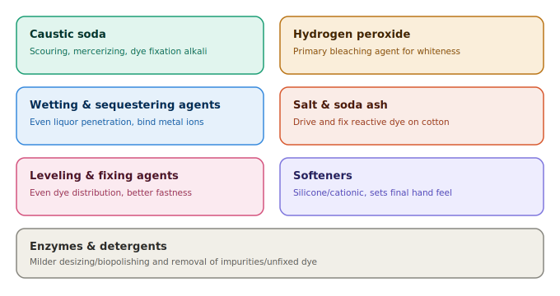
Wet processing depends on a defined set of chemical groups, each performing a specific function in the process chain. Therefore, understanding these functions — rather than detailed handling procedures — matters for merchandisers, students, and quality professionals.
Caustic soda (sodium hydroxide) is used in scouring, mercerization, and as an alkali for reactive dye fixation. Hydrogen peroxide serves as the primary bleaching agent for removing natural fiber color and achieving whiteness. Wetting agents reduce the surface tension of water, allowing processing liquors to penetrate fabric evenly and quickly. Sequestering (chelating) agents bind metal ions present in water or fiber that could otherwise interfere with bleaching and dyeing uniformity.
Detergents assist in removing oils, waxes, and impurities during scouring. They also help wash off unfixed dye after dyeing. Enzymes — including amylases for desizing and cellulases for biopolishing — offer targeted and generally milder alternatives to some conventional chemical treatments. Salt (sodium chloride or sodium sulfate) helps reactive dyeing drive dye exhaustion from the dyebath onto cellulosic fiber. Soda ash (sodium carbonate) provides the alkalinity needed for reactive dye fixation on cotton.
Acids, typically acetic acid, neutralize alkaline residues and set the pH required for acid dyeing. Leveling agents promote even dye distribution across the fabric, reducing the risk of shade streaks or patchiness. Fixing agents improve the wash and rub fastness of dyed or printed fabric by helping lock dye onto the fiber. Softeners — silicone, cationic, or specialty types — are applied at the finishing stage to achieve the target hand feel.
Every one of these chemical groups carries handling, storage, and discharge implications governed by occupational safety standards and local environmental regulations. However, this guide addresses their industrial purpose and function only, not handling procedures.
Quality Control in Textile Wet Processing
Quality control in wet processing verifies that a fabric batch meets the buyer’s technical specification before it moves to cutting. Therefore, technicians check several parameters at each stage and again during final inspection.
Shade matching compares dyed fabric against an approved lab dip or physical standard, usually under standardized lighting. Consequently, it remains one of the most common rejection points in bulk production. GSM (grams per square meter) verifies fabric weight against specification because finishing and shrinkage can shift GSM from the greige stage. Width confirms that the fabric meets the cuttable width required by the garment factory.
Shrinkage measures dimensional change after washing. This remains a critical parameter because excessive shrinkage can cause finished garments to fail size specifications after the consumer’s first wash. Spirality (skew) checks whether a knit fabric’s wale lines twist rather than run straight, which represents a common and costly knit-dyeing defect. Colorfastness undergoes testing across multiple stresses — washing, rubbing (crocking), and perspiration — because a fabric can pass one fastness test and fail another entirely.
Pilling resistance is tested through controlled abrasion. Hand feel is evaluated, often subjectively against an agreed reference swatch, alongside absorbency testing for fabrics where moisture uptake matters functionally. Tensile strength and tear strength confirm that the fabric retains adequate mechanical performance after all the chemical and thermal stress of wet processing. Finally, dimensional stability confirms that the fabric can hold its shape throughout the garment’s expected wear-and-wash life.
Poor wet processing quality cascades directly into garment-level problems. For example, off-shade lots trigger costly re-dyeing or rejection, while weak colorfastness causes consumer complaints and returns. Likewise, dimensional instability leads to size-spec failures that can void an entire shipment. Therefore, quality control remains embedded at multiple checkpoints throughout wet processing rather than only at the end.
Sustainable Textile Wet Processing Technology
Wet processing remains one of the most resource-intensive stages of textile manufacturing. Therefore, sustainability innovation in this field has accelerated significantly over the past decade.
Low-Liquor Ratio Dyeing
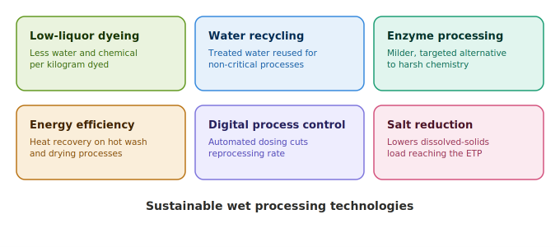
Traditional dyeing machines use a large ratio of water to fabric, known as the liquor ratio. Modern soft-flow and specialized low-liquor-ratio machines reduce this ratio substantially. As a result, they cut water, chemical, and energy consumption per kilogram of fabric dyed without compromising dyeing quality when properly optimized.
Water-Saving Technologies
Beyond liquor ratio reduction, technologies such as air-flow (airjet) dyeing machines and optimized rinse-cycle programming reduce total water consumption per batch. This has become increasingly important for mills operating in water-stressed regions.
Enzyme-Based Processing
Enzymatic desizing and biopolishing can replace or reduce harsher chemical treatments. In many cases, these processes operate at milder temperatures and pH, which can lower both chemical load and energy use. However, enzyme processes require tighter process control to achieve consistent results.
Salt Reduction
Because conventional reactive dyeing depends heavily on salt for dye exhaustion, mills increasingly adopt salt-reduced or low-salt reactive dyeing processes and specialty low-salt dye ranges. Consequently, these technologies can reduce the dissolved-solids load that ultimately reaches the effluent treatment plant.
Chemical Management
Structured chemical management — including supplier chemical inventories screened against restricted substance lists such as ZDHC’s Manufacturing Restricted Substances List (MRSL) — helps mills reduce hazardous chemical use. Moreover, it helps them demonstrate compliance to international buyers.
Water Recycling
Treated wastewater can return to non-critical processes such as rinsing or utility use. Therefore, mills can reduce net freshwater withdrawal, particularly when they combine recycling with the advanced treatment technologies described in the wastewater section below.
Energy Efficiency
Heat-recovery systems on hot wash and drying processes, along with insulated machinery and optimized process recipes, reduce the substantial thermal energy demand of wet processing. This demand typically represents one of the largest energy consumption areas in a textile mill.
Digital Process Control
Automated dosing, real-time monitoring, and digital recipe management reduce reprocessing, or re-dyeing, caused by human error. Furthermore, avoiding reprocessing itself represents one of the most effective sustainability measures because every re-dyed batch consumes water, chemicals, and energy a second time.
Waterless / Near-Waterless Technologies
Emerging technologies such as supercritical CO2 dyeing, used commercially for polyester in specific installations, and foam-based application systems can substantially reduce water use for certain processes and fiber types. However, these technologies remain more limited in scale and fiber applicability than conventional water-based dyeing. Therefore, mills should view them as promising and growing technologies rather than wholesale industry replacements at this time.
Textile Wastewater and Effluent Treatment
Wet processing is inherently water-intensive. Consequently, virtually every stage — desizing, scouring, bleaching, dyeing, printing, and washing — generates wastewater carrying process residues.
Textile wastewater carries several distinct pollutant loads. Dyeing effluent carries unfixed dye, which remains highly visible even at low concentrations and represents one of the most regulated parameters. Chemical load includes residual caustic, salts, surfactants, and finishing agents. Color itself represents a regulated discharge parameter because it affects receiving water bodies visually and biologically. COD (chemical oxygen demand) and BOD (biological oxygen demand) measure organic pollutant load. Meanwhile, TDS (total dissolved solids) reflects salts and dissolved chemicals, while pH requires control because scouring and dyeing liquors can remain strongly alkaline or acidic before treatment.
What Is an ETP?
An Effluent Treatment Plant (ETP) is the on-site or shared facility that treats textile wastewater to remove or reduce pollutants before discharge. Consequently, the ETP brings the water to a quality that meets regulatory discharge standards.
Basic Textile ETP Process
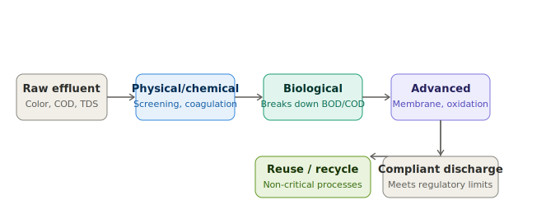
A conventional textile ETP typically combines physical treatment, including screening and equalization, to buffer flow and pollutant variation. It then uses chemical treatment, including coagulation and flocculation, to remove color and suspended solids. Finally, biological treatment breaks down organic pollutants, followed by sludge handling and final polishing before discharge.
Biological Treatment
Biological treatment uses microorganisms to consume and break down organic pollutants in wastewater. Mills most commonly use activated sludge or similar biological reactor systems. Therefore, this stage remains central to reducing BOD and COD to acceptable discharge levels.
Advanced Treatment
Advanced or tertiary treatment technologies — such as membrane filtration, advanced oxidation, and activated carbon polishing — target pollutants that conventional biological treatment cannot fully remove. These include residual color and certain dissolved solids. As discharge standards tighten, mills increasingly consider these technologies.
Water Reuse and Recycling
Advanced-treated effluent can return to the mill for non-sensitive processes. Therefore, mills can reduce their dependence on fresh groundwater or surface water sources. This becomes especially significant in industrial clusters where multiple mills draw from the same water table.
Zero Liquid Discharge (ZLD)
Zero Liquid Discharge systems aim to treat wastewater until essentially no liquid effluent leaves the facility. These systems recover clean water for reuse and separate solid salts or residues for disposal or further use. Although ZLD remains technically achievable and is mandated in some jurisdictions for specific industrial categories, it requires substantial energy and investment. Therefore, its economic feasibility depends heavily on local energy costs, effluent characteristics, and regulatory requirements. Mills should present ZLD as a genuine but demanding technology rather than a universally adopted standard.
Textile Wet Processing Technology in Bangladesh
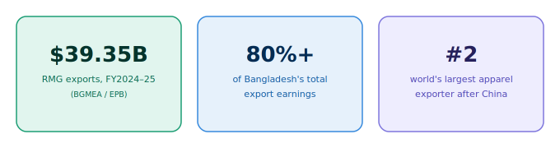
Textile Wet processing plays a critical role in Bangladesh’s textile and apparel industry, one of the world’s largest ready-made garment (RMG) exporters. Bangladesh’s RMG exports reached roughly USD 39.35 billion in FY2024–25, making the sector a major contributor to the country’s export earnings and supporting its position as the world’s second-largest apparel exporter after China.
Because Bangladesh exports large volumes of finished, dyed, printed, and washed textiles, wet processing capacity remains a major competitive advantage. The industry includes knit dyeing, woven fabric processing, and denim washing, all of which support different apparel segments.
Knit dyeing accounts for a significant share of wet processing, supporting products such as T-shirts, polo shirts, and basic knitwear. Woven processing serves shirting, bottoms, and workwear, often using continuous pretreatment and dyeing ranges for open-width fabrics. Meanwhile, denim processing and washing combine indigo (vat) dyeing with mechanical and chemical washing effects required by global denim brands.
Buyer compliance also plays an important role. International apparel buyers commonly require mills to follow programs such as ZDHC (Zero Discharge of Hazardous Chemicals), Higg Index environmental modules, and buyer-specific restricted substance lists. Functional ETPs have also become a basic sourcing requirement.
Furthermore, water management, ETP operation, chemical management, and energy efficiency remain major priorities for Bangladeshi mills. These areas help mills meet Department of Environment requirements and satisfy international sustainability audits.
For sourcing professionals and buying houses, a mill’s dyeing technology, ETP standards, and compliance certifications now play an important role in supplier selection. Ultimately, consistent color, reliable fastness, environmental compliance, and proper documentation can directly influence order placement with international apparel brands.
Modern Textile Wet Processing Technologies
Textile Wet processing has moved decisively toward automation and data-driven control over the past decade. Furthermore, this shift continues to accelerate.
Automation now spans automatic chemical dosing systems, programmable dyeing machine controllers, and automated material handling between process stages. Consequently, these systems reduce manual variability. Digital color management, supported by spectrophotometers, allows laboratories to measure and communicate color numerically rather than relying purely on visual matching. As a result, this technology speeds up lab-dip approval and improves shade-matching accuracy between a mill and its buyer.
Automated chemical dosing improves recipe repeatability by removing manual measurement error. Therefore, it directly reduces reprocessing rates. Real-time process monitoring tracks temperature, pH, and liquor levels throughout a dyeing cycle and flags deviations before they cause a batch failure.
Moreover, AI-assisted process control and broader Industry 4.0 adoption are beginning to enable predictive quality control. Process data can flag likely defects before a batch completes. Similarly, data-driven dye recipe optimization uses historical recipe and outcome data to inform more accurate first-time-right dye recipes.
Collectively, these technologies improve shade consistency, productivity, water efficiency, chemical efficiency, energy efficiency, and overall quality. Most importantly, they improve batch-to-batch repeatability, which reduces reprocessing that would otherwise erode both margin and sustainability performance.
Common Textile Wet Processing Problems and Defects
Even well-run textile wet processing operations encounter recurring defect categories. Therefore, understanding cause and effect helps both technologists and merchandisers diagnose problems faster.
Shade variation between batches usually results from inconsistent recipe application, water quality changes, or machine-to-machine differences. Consequently, it can result in rejected or discounted fabric. Standardized recipes, water quality control, and spectrophotometric shade verification help prevent it.
Uneven dyeing across a single piece typically stems from poor pretreatment, inadequate liquor circulation, or an incorrect dye addition rate. This produces visible patchiness. Therefore, consistent scouring and controlled, gradual dye addition reduce the risk.
Color bleeding during washing usually indicates incomplete dye fixation or inadequate wash-off. As a result, it can stain adjacent lighter fabrics. Proper fixation chemistry and thorough post-dyeing washing address the problem.
Poor colorfastness generally traces back to wrong dye class selection, under-dosed fixing agents, or incomplete curing. Consequently, it can cause garment returns after minimal wear. Correct dye-fiber matching and validated fixation processes provide the main preventive measures.
Crease marks form when fabric folds set under heat or tension during processing. They occur most often in rope-form dyeing machines and leave permanent lines. Therefore, open-width processing or gentler rope-handling reduces the risk.
Problems and Defects
GSM variation and width variation typically result from inconsistent stentering or tension control. Consequently, they can cause out-of-spec fabric. Calibrated stenter settings and regular in-process checks help prevent these defects.
Excessive shrinkage usually stems from insufficient heat-setting or compacting. As a result, garments can fail size specifications after washing. Correct compacting and pre-shrinkage treatment address the problem directly.
Spirality in knit fabric commonly results from yarn twist liveliness or uneven finishing tension. This produces twisted seams in finished garments. Therefore, balanced yarn twist and controlled finishing tension provide the standard prevention approach.
Poor hand feel often results from incorrect or insufficient softener application or residual alkalinity from earlier stages. Consequently, the fabric may feel harsh or rough. Correct neutralization and softener dosing resolve this issue.
Staining can result from machine contamination, hard water minerals, or chemical incompatibility. These factors can leave localized marks. Therefore, regular machine cleaning and water quality monitoring reduce the risk.
Pilling depends on fiber type, yarn structure, and insufficient anti-pilling treatment. It produces surface fiber balls during wear. Consequently, anti-pilling finishing and biopolishing help control it.
Uneven finishing typically comes from inconsistent padder pressure or uneven curing temperature across the fabric width. This can cause patchy hand feel or performance. Regular equipment calibration helps prevent it.
10. Comparison Tables
Textile Wet Processing Stage — Purpose and Result
| Wet Processing Stage | Main Purpose | Typical Result |
|---|---|---|
| Desizing | Remove sizing agents applied before weaving | Even chemical/dye penetration |
| Scouring | Remove natural waxes, oils, and impurities | Clean, absorbent fabric |
| Bleaching | Remove natural fiber color | Required whiteness/brightness |
| Mercerization | Swell cotton fiber under caustic and tension | Increased luster, strength, dye affinity |
| Singeing | Burn off surface fiber fuzz | Smoother surface, reduced pilling |
| Dyeing | Apply permanent color | Target shade with required fastness |
| Printing | Apply localized color patterns | Designed print with fastness properties |
| Washing | Remove unfixed dye and chemicals | Clean, colorfast fabric surface |
| Finishing | Apply mechanical/chemical treatments | Target hand feel, stability, function |
Dye Type — Fiber, Application and Advantage
| Dye Type | Suitable Fiber | Main Application | Key Advantage |
|---|---|---|---|
| Reactive | Cotton, cellulosics | Knit/woven cotton apparel | Excellent wash fastness, wide gamut |
| Disperse | Polyester, synthetics | Activewear, polyester apparel | Strong fastness on synthetics |
| Acid | Wool, silk, nylon | Fine wool/silk, nylon activewear | Bright, vibrant shades |
| Direct | Cotton, cellulosics | Lower-cost cellulosic goods | Simple, economical application |
| Vat | Cotton, especially denim | Denim, workwear | Outstanding wash/light fastness |
| Pigment | Almost any fiber | Casualwear, garment dyeing | Low water use, soft-faded hand |
| Sulfur | Cotton, dark shades | Workwear, casual bottoms | Economical deep/dark shades |
Textile Wet Processing — Resource Use and Sustainability Potential
| Technology | Water Use | Chemical Use | Sustainability Potential |
|---|---|---|---|
| Conventional jet/winch dyeing | High | Moderate–High | Baseline technology |
| Low-liquor-ratio soft-flow dyeing | Reduced | Reduced | High, widely adoptable |
| Enzyme-based pretreatment | Moderate | Reduced hazardous load | Moderate–High |
| Digital textile printing | Low, no screen wash-out | Low | High for short-run/complex designs |
| Supercritical CO2 dyeing | Very low, polyester only | Low | High but limited fiber/scale applicability |
| Zero Liquid Discharge (ZLD) | Near-zero discharge | N/A, treatment stage | High, but energy- and cost-intensive |
Common Defects in textile wet process— Cause and Prevention
| Common Defect | Possible Cause | Prevention |
|---|---|---|
| Shade variation | Inconsistent recipe, water quality shifts | Standardized recipes, spectrophotometric checks |
| Uneven dyeing | Poor pretreatment, weak circulation | Consistent scouring, controlled dye addition |
| Color bleeding | Incomplete fixation/wash-off | Proper fixation chemistry, thorough washing |
| Poor colorfastness | Wrong dye class, under-dosed fixative | Correct dye-fiber matching, validated fixation |
| Crease marks | Fold-setting under heat/tension | Open-width processing, gentle handling |
| Excessive shrinkage | Insufficient heat-setting/compacting | Correct compacting, pre-shrinkage treatment |
| Spirality | Yarn twist liveliness, uneven tension | Balanced yarn twist, controlled finishing tension |
| Pilling | Fiber type, weak anti-pilling treatment | Anti-pilling finish, biopolishing |
11. FAQ Section
Section 1
What is textile wet processing? Textile wet processing is the set of chemical and mechanical operations — pretreatment, dyeing, printing, and finishing — that use water, heat, and chemicals to clean, color, and finish grey fabric. As a result, the fabric becomes market-ready textile suitable for apparel manufacturing.
What are the main stages of wet processing? The main stages include pretreatment (desizing, scouring, bleaching, mercerization, singeing), dyeing, printing where applicable, washing, and finishing. Finally, quality inspection takes place before the factory approves the fabric for garment cutting.
What is pretreatment in textile processing? Pretreatment prepares grey fabric for dyeing and finishing by removing sizing agents, natural impurities, waxes, and unwanted color. Therefore, the fabric can absorb dye and chemicals evenly and achieve the required whiteness or shade base.
What is the difference between dyeing and finishing? Dyeing applies permanent color to the fiber, while finishing applies mechanical and chemical treatments after dyeing. These treatments set the fabric’s hand feel, dimensional stability, and functional performance, such as softness or water repellency.
What chemicals are used in textile wet processing? Common chemicals include caustic soda, hydrogen peroxide, wetting agents, sequestering agents, detergents, enzymes, salt, soda ash, acids, leveling agents, fixing agents, and softeners. Each chemical group serves a specific function across pretreatment, dyeing, and finishing.
What is reactive dyeing? Reactive dyeing is the dominant dyeing method for cotton and other cellulosic fibers. In this process, the dye forms a covalent chemical bond with the fiber, delivering excellent wash fastness across a wide color gamut.
Section 2
What is textile finishing? Textile finishing is the final wet processing stage that applies mechanical and chemical treatments — such as softening, anti-pilling, moisture management, and water-repellent finishes — to give fabric its final hand feel and functional performance.
Why is wet processing important? Wet processing determines a fabric’s appearance, color, hand feel, comfort, performance, and colorfastness. Therefore, it represents the stage where plain grey fabric gains much of the commercial value that apparel buyers and consumers actually pay for.
What is sustainable wet processing? Sustainable wet processing refers to technologies and practices — such as low-liquor-ratio dyeing, water recycling, enzyme-based processing, and chemical management — that reduce the water, chemical, and energy footprint of textile pretreatment, dyeing, and finishing.
What is low-liquor dyeing? Low-liquor-ratio dyeing uses less water relative to the weight of fabric being dyed compared with conventional machines. Consequently, it reduces water, chemical, and energy consumption per batch without necessarily compromising dyeing quality.
What is an ETP in the textile industry? An Effluent Treatment Plant (ETP) is a facility that treats textile wastewater by removing color, chemical load, and organic pollutants. As a result, the treated water can meet regulatory discharge standards before it leaves the mill.
What is ZLD? Zero Liquid Discharge (ZLD) is a wastewater treatment approach designed to eliminate liquid effluent discharge entirely. It recovers clean water for reuse and separates solid salts or residues, although it requires significant energy and capital investment.
What are common wet processing defects? Common defects include shade variation, uneven dyeing, color bleeding, poor colorfastness, crease marks, excessive shrinkage, spirality, and pilling. Most of these problems trace back to inconsistent process control during pretreatment, dyeing, or finishing.
Section 3
How does wet processing affect garment quality? Wet processing quality directly determines a garment’s final color accuracy, colorfastness, dimensional stability, and hand feel. Therefore, defects introduced during this stage — such as off-shade lots or excessive shrinkage — often cannot be corrected later in garment manufacturing.
What is the future of textile wet processing? The future of wet processing centers on automation, digital color management, AI-assisted process control, and continued adoption of water- and chemical-saving technologies. These developments are driven by both cost pressure and increasingly strict buyer sustainability requirements.
Learn it. Source it. Produce it. Partner with JNC Fashion Ltd. for reliable apparel sourcing and merchandising solutions.