Apparel Manufacturing in 2026
1. Introduction: A Craft Reinvented by Technology
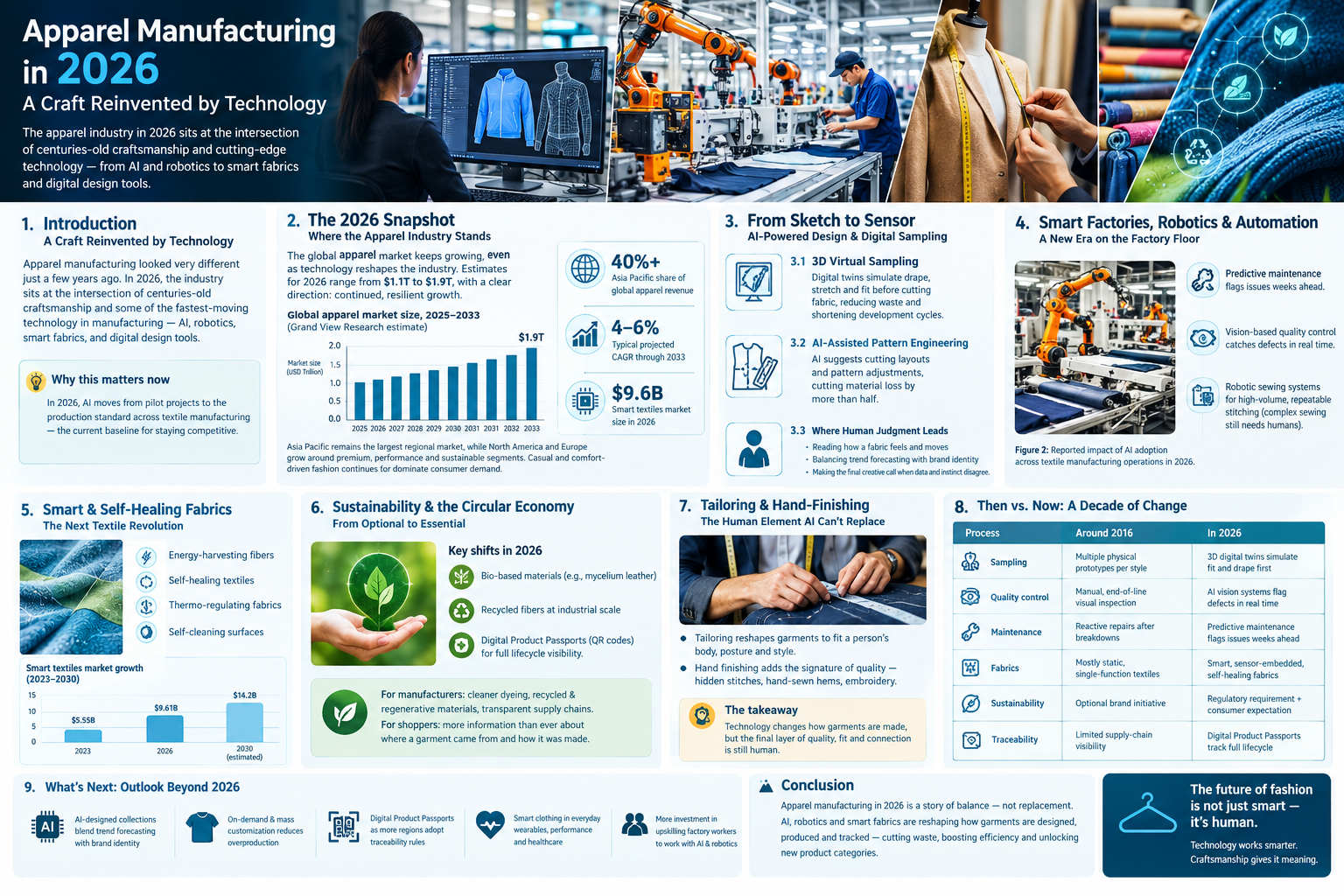
Apparel manufacturing looked very different just a few years ago. In 2026, the industry sits at the intersection of centuries-old craftsmanship and some of the fastest-moving technology in manufacturing — artificial intelligence, robotics, smart fabrics, and digital design tools that did not exist in mainstream production a decade ago.
This guide takes a broad, up-to-date look at apparel manufacturing in 2026: the market forces driving change, the tools reshaping factories and design studios, and the human skills that remain irreplaceable even as automation accelerates.
| Why this matters now
2026 is widely described by industry analysts as the year AI moves from pilot projects to the production standard across textile manufacturing — not a future trend, but the current baseline for staying competitive. |
2. The 2026 Snapshot: Where the Apparel Industry Stands
The global apparel market has kept growing steadily, even as the industry undergoes major technological change. Depending on the research firm, 2026 estimates range from roughly $1.1 trillion to $1.9 trillion, reflecting differences in scope and methodology — but the direction is the same across the board: continued, resilient growth.
Figure 1: Global apparel market size, 2025–2033 (Grand View Research estimate).
Asia Pacific remains the largest regional market, while North America and Europe continue to grow around premium, performance, and sustainable apparel segments. Casual and comfort-driven fashion continues to dominate consumer demand, a trend accelerated by remote and hybrid lifestyles.
| 40%+
Asia Pacific share of global apparel revenue |
4–6%
Typical projected CAGR through 2033 |
$9.6B
Smart textiles market size in 2026 |
3. From Sketch to Sensor: AI-Powered Design & Digital Sampling
Pattern making has always required a deep understanding of the human body, fabric behavior, and aesthetics. In 2026, that process is increasingly supported — not replaced — by digital tools.
3.1 Digital Twins and 3D Virtual Sampling
Instead of producing multiple physical samples, many design teams now build a digital twin of a garment — a 3D model that simulates drape, stretch, and fit before a single piece of fabric is cut. This shortens development cycles and cuts material waste, since flaws can be caught on screen rather than in a wasted sample.
3.2 AI-Assisted Pattern Engineering
AI tools can now suggest cutting layouts and pattern adjustments that reduce fabric waste, in some cases cutting material loss by more than half through predictive pattern engineering and automated production planning.
3.3 Where Human Judgment Still Leads
- Reading how a fabric will actually feel and move on a real body
- Balancing trend forecasting with brand identity and taste
- Making the final creative call when data and instinct disagree
4. Apparel Manufacturing: Smart Factories, Robotics & Automation
On the factory floor, 2026 marks a turning point for apparel manufacturing. Predictive maintenance, once a competitive edge, is now considered a baseline expectation for mills and garment factories that want to stay cost-competitive. AI-powered sensors can flag a failing motor or worn bearing weeks before it breaks down.
Figure 2: Reported impact of AI adoption across textile manufacturing operations in 2026.
Vision-based quality control is also replacing manual end-of-line inspection in many factories, using computer vision to catch fabric defects at a speed and consistency human inspectors can’t match over long shifts. Robotic sewing systems, still an emerging category, are being piloted for high-volume, repeatable stitching tasks — while complex, garment-specific sewing remains largely a human skill.
5. Smart & Self-Healing Fabrics: The Next Textile Revolution
Perhaps the most futuristic corner of textile garment technology in 2026 is the fabric itself. The global smart textiles market has grown rapidly — from roughly $5.55 billion in 2023 to about $9.61 billion in 2026 — driven by fabrics that do far more than cover the body.
Figure 3: Smart textiles market growth, 2023–2030 (2030 figure is a trend-based estimate).
5.1 What “smart” fabric means in 2026
- Energy-harvesting fibers that capture movement or body heat to power small sensors
- Self-healing textiles that use micro-encapsulated agents to repair small tears
- Phase-change and thermo-regulating fabrics that adjust to temperature automatically
- Nano-engineered, self-cleaning surfaces for performance and medical textiles
These aren’t niche lab experiments anymore — major industry trade fairs in 2026 have dedicated significant floor space to smart textile exhibitors, signaling that brands see this as a standard feature, not a gimmick.
6. Sustainability & the Circular Economy in 2026
Sustainability is no longer a side initiative in garment technology — it’s a regulatory and consumer expectation. The EU’s environmental regulations, along with rising consumer awareness, are pushing bio-based materials and recycled fibers toward industrial-scale adoption.
| Key sustainability shifts in 2026
Bio-based alternatives such as mushroom-based (mycelium) leather are scaling up, recycled fiber use is expanding, and Digital Product Passports — QR-code-based records embedded in garments — are giving brands and shoppers full lifecycle visibility from raw fiber to finished product. |
For manufacturers, this means investing in cleaner dyeing processes, recycled and regenerative materials, and transparent supply chains. For shoppers, it means more information than ever about where a garment came from and how it was made — often accessible with a simple scan.
7. Tailoring & Hand-Finishing: The Human Element AI Can’t Replace
Even with all this technology, the most valued garments in 2026 still rely on distinctly human skills. Tailoring is where science and artistry meet — a tailor doesn’t just alter a garment, they reshape it around a person’s body, posture, and personal style through careful measurement and repeated fitting.
Hand finishing remains the quiet signature of quality: hidden stitches along a lapel, hand-sewn hems, and detailed embroidery are marks of craftsmanship that automation still can’t fully replicate. These finishing touches reflect patience and judgment that come only from experience.
| The takeaway
Technology is changing how garments are designed, produced, and monitored — but the final layer of quality, fit, and personal connection between maker and wearer is still a human contribution. |
8. Then vs. Now: A Decade of Change at a Glance
| Process | Around 2016 | In 2026 |
| Sampling | Multiple physical prototypes per style | 3D digital twins simulate fit and drape first |
| Quality control | Manual, end-of-line visual inspection | AI vision systems flag defects in real time |
| Maintenance | Reactive repairs after breakdowns | Predictive maintenance flags issues weeks ahead |
| Fabrics | Mostly static, single-function textiles | Smart, sensor-embedded, self-healing fabrics |
| Sustainability | Optional brand initiative | Regulatory requirement + consumer expectation |
| Traceability | Limited supply-chain visibility | Digital Product Passports track full lifecycle |
9. What’s Next: Outlook Beyond 2026
- Wider adoption of AI-designed collections that blend trend forecasting with brand identity
- Continued growth of on-demand and mass-customization manufacturing, reducing overproduction
- Expansion of Digital Product Passports as more regions adopt EU-style traceability rules
- Smart clothing moving from niche wearables into everyday performance and healthcare apparel
- Greater investment in upskilling factory workers to operate alongside AI and robotics
10. Conclusion
Apparel manufacturing in 2026 tells a story of balance rather than replacement. Artificial intelligence, robotics, and smart fabrics are reshaping how garments are designed, produced, and tracked — cutting waste, boosting efficiency, and unlocking entirely new product categories.
At the same time, the qualities that make a garment feel special — thoughtful design, precise tailoring, and hand-finished detail — remain deeply human. The brands and manufacturers succeeding in 2026 are the ones combining both: using technology to work smarter, while protecting the craftsmanship that gives clothing its meaning.