
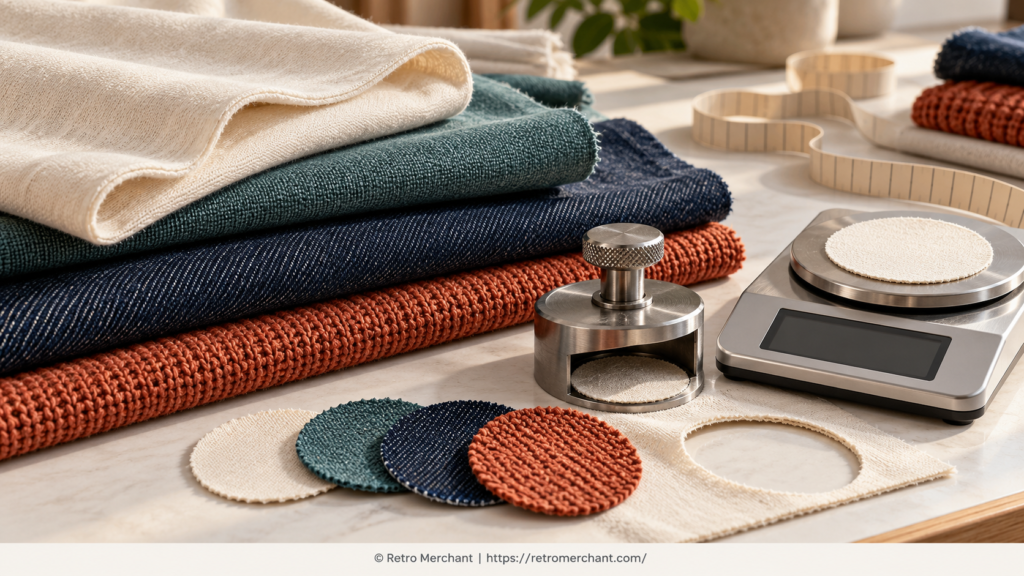
GSM is one of the first numbers you see on a fabric spec, and one of the most misunderstood.
Practical fabric-weight knowledge for textile students, junior merchandisers and garment professionals.
If you work in apparel, you will quote, compare and approve fabrics by GSM every week. Yet many beginners treat it as a measure of thickness or quality, and that leads to costly mistakes. This guide covers 10 GSM facts, each with an example and a practical tip you can use in merchandising work.
What Is GSM in Fabric?
GSM stands for grams per square metre (g/m²): the mass of one square metre of fabric. A higher GSM means more fabric mass in the same area. It measures weight, not thickness or quality, and it is quoted for the fabric, not for the finished garment.
| Typical GSM guide (approximate) | GSM range |
|---|---|
| Light tee, summer wear | 120–160 |
| Standard tee | 160–200 |
| Heavy tee, polo | 200–260 |
| Fleece, hoodie | 250–350 |
FACT 1
GSM Does Not Mean Thickness
Fabric weight, thickness and perceived heaviness are three different things.
Mass of fabric in one square metre. Measured with a cutter and balance. Unit: g/m².
Distance between the two fabric faces. Measured with a thickness gauge. Unit: mm.
How heavy the fabric feels in hand, shaped by fibre, yarn, loft and finish. Judged by touch.
Two 180 GSM fabrics can differ in thickness, softness and feel because of fibre, yarn and construction.
FACT 2
Same GSM, Different Feel
Here are three knit fabrics at about 230 GSM:
| Fabric (~230 GSM) | Structure and feel | Typical use |
|---|---|---|
| Single jersey | One-layer loops. Lighter hand, good drape, curls at the edges. | T-shirts |
| Interlock | Two interlocked layers. Smooth, dense, stable and less curling. | Polos, premium tees |
| Fleece (brushed back) | Brushed pile traps air. Bulky, soft and warmer. | Hoodies, sweatshirts |
FACT 3
Why GSM Matters in Costing
Fabric is bought by the kilogram, but garments are cut by area. Higher GSM means more kilograms for the same garment.
Example: one T-shirt uses 0.9 m² of fabric. That is 144 g at 160 GSM and 198 g at 220 GSM. At $5.00 per kg:
Illustrative figures only. Use your own quotations.
FACTS 4 + 5
The Round GSM Cutter and the Calculation
A standard GSM cutter cuts a round specimen of exactly 100 cm² (diameter about 11.28 cm). Then:
- Cut a round specimen with the 100 cm² GSM cutter.
- Weigh it on a precision balance in grams.
- Multiply the weight by 100 to get g/m².
Why ×100? Because 1 m² = 10,000 cm² = 100 × (100 cm²).
FACT 6
The Same T-Shirt, Two GSMs
144 g fabric in one tee (0.9 m²)
Light, airy, drapes easily. Suits summer wear, but light colours may show through.
1,000 tees = 144 kg fabric
198 g fabric in one tee (0.9 m²)
Substantial, opaque, holds shape. Warmer, but costs and ships heavier.
1,000 tees = 198 kg fabric
Same pattern, same size: that is 54 g more fabric per tee (+37.5%) at 220 GSM.
FACT 7
Wet Processing Changes GSM
Knit fabric changes during dyeing and finishing. When fabric shrinks or relaxes, the same mass sits in a smaller area, so GSM rises. When it is stretched in finishing, GSM falls. Softeners, brushing and compacting also change mass or loft.
180 ÷ 0.92 ≈ 196 GSM
Illustrative: 180 GSM with 8% area shrinkage or 10% area gain.
FACT 8
GSM Variation and Quality
Every fabric has an approved GSM and a tolerance. For example, 180 GSM ± 5% gives a pass range of 171–189 GSM. A reading of 168 fails, 176 passes and 192 fails. Too low means less fabric and a quality risk. Too high means more cost and a different feel.
Merchandiser checklist
- Get the approved GSM and tolerance.
- Test several rolls and areas.
- Condition the sample before weighing.
- Check finished GSM, not greige.
- Record results and flag deviations.
FACT 9
GSM and Fabric Construction
GSM is simply how much yarn sits in each square metre. Four things mainly set it:
| Factor | Effect on GSM |
|---|---|
| Yarn count | Finer yarn (higher Ne) gives lighter fabric. Coarser yarn gives heavier fabric. |
| Stitch length | A shorter stitch packs more yarn per area, so GSM rises. A longer stitch lowers it. |
| Loop structure | Interlock and rib use more yarn per area than single jersey. |
| Finishing | Compacting, brushing and shrinkage control change the final GSM. |
FACT 10
Higher GSM Is Not Always Better
Uneven or low-grade yarn
Loose, unbalanced knitting
Poor dyeing, shade variation
Weak finishing, shrinks and pills
Clean, consistent yarn
Balanced, stable knitting
Even dyeing, good fastness
Good finishing, soft hand
Choose GSM by end use, durability, comfort and construction, not weight alone.
Frequently Asked Questions About GSM
What does GSM mean in fabric?
GSM means grams per square metre. It is the weight of one square metre of fabric.
How do you calculate GSM?
Cut a 100 cm² round specimen, weigh it in grams and multiply by 100.
Is higher GSM better quality?
No. Quality depends on yarn, knitting, dyeing and finishing as well as weight.
Key Takeaways
- GSM is weight per area, not thickness.
- The same GSM can feel very different.
- GSM drives fabric consumption and cost.
- Specimen weight × 100 = GSM (100 cm² cutter).
- Check finished GSM against spec and tolerance.
- Higher GSM is not always better quality.
Learn more about textiles, fabric and apparel merchandising at retromerchant.com.

